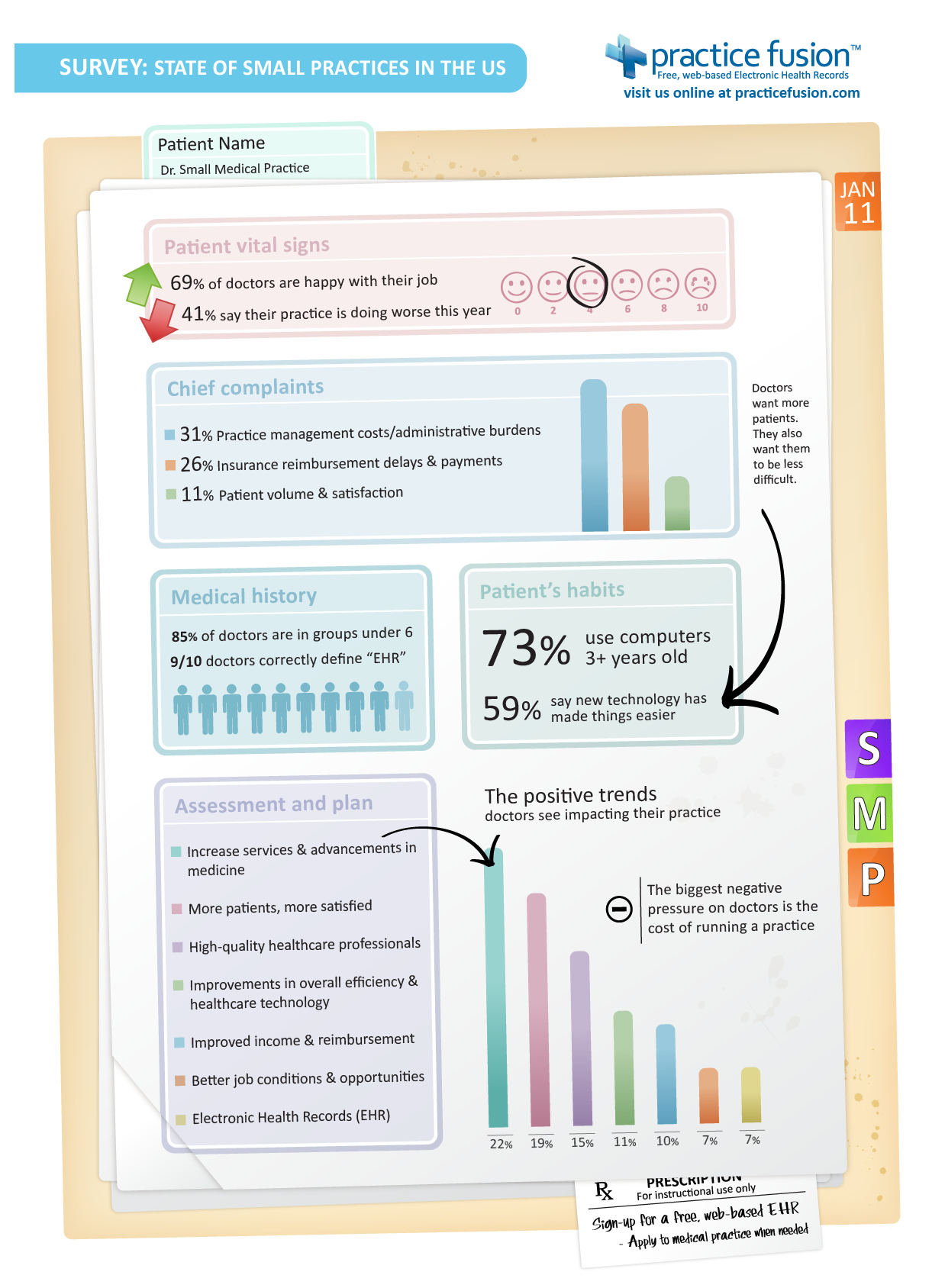
What a revealing graphic. Practice Fusion continues to impress.
January 12, 2011
August 20, 2008
Reminding Patients To Take Their Medication
Patients being non-compliant with taking their medication negates the value of going to the doctor, creates confusion in setting up treatment plans and in the case of antibiotics teaches the exact bacteria you're trying to kill how to fight back (MRSA).Luckily, next generation devices such as Zuri aim to help remind patients to take their medication and also provide an electronic record of time and dosage to the doctor. Real-time interfacing with your medical provider is the only way to monitor medication activity successfully.
Here's more from the WSJ.
...the Zuri, an iPod-sized device that sends patients reminders to take their medications and records their compliance, which users and, if they choose, their doctors can track through a companion Web page.
Intel's care-management tool, called Health Guide, combines an in-home patient device with an online interface that doctors can use to monitor and remotely manage care. The in-home patient device collects readings from specific models of wired and wireless medical devices, such as blood-pressure monitors and glucose meters. It then displays the data for the patient on a touch screen and sends the readings to a secure host server, where health-care professionals can review the information and provide feedback via video conferencing and email.
Meanwhile, Microsoft is working with home-health and fitness-device makers to integrate vital-signs data into HealthVault, an online service the software company recently launched that allows consumers to store, manage and selectively share medical data.
August 4, 2008
Hellooooo Health!
- Original Website & Philosophy - In a nutshell, doctors making house calls like the old days with an iPhone packing in the patient records instead of a briefcase.
- The Video Brief - Think medical Facebook. Why not just add your doctor as a "friend" on a privatized network and message him with a problem?
- Summary Article on Hello Health Launch - Scalability is occurring one doctor at a time and I only foresee trailblazing growth in the future.
May 30, 2008
Eye-opening views from around the web
2. Bob Wachter providing a very detailed excerpt on the development of Google Health.
3. GPhone, or rather Android, demos!
4. A spiritual view of finding & fulfilling need (the business case for demand).
5. How mainstream media covers medical news.
May 29, 2008
Providing patients the means to monitor their own health
"Keeping [at-risk] patients stable and quickly getting them care when it's needed can reduce hospitalizations and cut the insurer's medical costs. And since the savings come from improving the patient's health and quality of life, programs such as Blue Cross' "Your Heart Matters" are generally popular with participants."That's from this article detailing how the above congestive heart failure (CHF) program works remotely from patient's homes.
"Every morning, Sedaris steps on a special digital scale beside the bed in her Raleigh home and answers a series of questions. Is she swollen or short of breath? Has she taken her medicines? The scale, provided by her health insurer, ships her weight and other data to a nurse's computer at Blue Cross and Blue Shield's disease management center in Winston-Salem. Any suspicious results -- an overnight weight gain of just a pound or two is a signal that Sedaris is retaining fluid that may strain her heart -- and the nurse is on the phone. She'll talk with Sedaris and, if necessary, send her to get medical attention.This is incredible! For more, here's another personal example from the Healthcare Economist.
The technology to remotely monitor patients' pulse, weight, blood pressure, blood-oxygen levels, general mobility and other indicators is already widely available. The declining costs and increasing use of high-speed Internet service should only accelerate acceptance of monitoring devices."
May 6, 2008
Your Future Doctor will see you Now
"On the doctor side, I have a facebook-like platform that allows me to see and receive client updates and communicate via email, IM, video, and SMS with my clients and colleagues. We don’t do eVisits — we simply communicate normally via a whole range of communication options to help streamline healthcare delivery."Hello Health!
May 2, 2008
Second-hand Health Care: Why Health 2.0 is Lagging
Looks like the open market making up for gov't inefficiencies. At first it seems like a salvation army effort to donate something that still works but isn't useful to the hospitals (like donating an old phone system), but look at it long-term and you see that it only slows down the transition from paper to electronic records.
Here's why: using a sub-par, used EMR system in your practice isn't going to help your practice if the doc next door buys a state-of-the-art system. Plus, interfacing not conversion is the more important issue. The EMR has to talk to other EMRs, pharmacies, scheduling systems. Old systems don't have this capability. The main reason I'm against this is because a practice's paper process indicates how well its electronic process will be. So if you make a lot of medical errors on paper, you'll probably do the same (if not worse) on an electronic system.
Bottomline: Bush passes initiative (in 2001) to have every practice/hospital on an EMR by 2014. He doesn't provide ANY financial help whatsoever to make this happen. Hospitals try to convert on the cheap and realize they need to upgrade within the next 5 years. Having an EMR becomes the cost of doing business, like having credit card machines at a department store. Financing (the money it costs to implement) is a NON-ISSUE. Do it well the first time, don't take hand-me downs and upgrade faster than the next guy. Adopting early makes you better off in the long run.
April 24, 2008
We need a Medical Facebook
PHRs are ubiquitous - hospitals, insurers, popular medical websites all provide them - but people rarely use or update them. You put your information in, register a login and never look at it again. Why? Because its not connected to anyone. Even with all your medical info in one place, you don't have the ability to share that information very easily. Docs have to know about it, support it and use it in order for it to work. Otherwise, its just a Facebook profile without any friends!
Here's another reason why PHRs won't take off any time soon:
"Tethered" means linked only to a provider or a hospital and "standalone" refers to a web-based service like WebMD or Microsoft's HealthVault. Its hard to build a Facebook, let alone a medically-based version with all the privacy/security issues involved. The need is obviously there. PHRs won't take off without it.EDIT: Doctors don't trust PHRs because they don't link to anything they use on a regular basis. Get connected!
March 15, 2008
The oh-so-close horizon
Have you noticed how the word, "vista" has been popping up everywhere?? Considering definition #3, I understand why and it makes even more sense in the corporate view of things. Strategic planning meets Marketing, right? Here are a few more instances:Vista (vist-uh) n.
1. a view or prospect, esp. one seen through a long, narrow avenue or passage, as between rows of trees or houses.
2. such an avenue or passage, esp. when formally planned.
3. a far-reaching mental view: vistas of the future.
- WorldVistA
- AmeriCorps VISTA (Volunteers in Service to America)
- the Rx variety of course...Evista
- and c'mon now...Windows Vista
February 28, 2008
Google Health Teaser
Today, Google released a few teaser screenshots!
February 21, 2008
Get your Vitals Taken
Anyway, overall the site is really user-friendly. You can find a doc, figure out who to see for your problem and even rate the physician after your visit. Now it just needs critical mass.
January 28, 2008
A Marketplace for Health Care
"Consumption is the sole end and purpose of all production; and the interest of the producer ought to be attended to, only so far as it may be necessary for promoting that of the consumer."Carol is a health care marketplace that basically allows you to purchase care packages for what you need. Say you have a sore throat and you're worried it might be something worse. Using Carol's body chart, you click on the throat region, scroll down to sore throat and click on the test, treatment or procedure that most suits your condition. In this case, the options are mononucleosis (mono) symptoms: evaluation & treatment and sore throat: evaluation & management. Clicking on the latter leads to a "compare care packages" page where you can select a vendor based on price and facility.
--Adam Smith
This is a really innovative way of shopping for health care services. With a "shopping bag" as the checkout cart, bright colors and stylistic fonts, it feels more like you're shopping for clothes on Macy's site than buying an MRI for your knee. The prices are within reason but for now I only see people using this as supplemental insurance (especially for dental care) or if they're lacking insurance for some time. If I were old or poor though, several things would prohibit me from taking advantage of this service; (1) ready access to the internet, (2) tech-savvyness (3) scope of care...oh and the fact that Medicare and Medicaid exist.
What's hard for everyone is terminology. I had no idea what blepharoplasty was until I clicked on it (its eyelid surgery). On the other end of the coin, now I know exactly what it is! Its a great way to learn about health care; the real costs, different insurance models, and how it can be delivered.
Right now we have very little choice. Not anything that's affordable for sure. Carol, while a work in progress, is making headway in providing consumers options to choose from. Making health care more transparent is business everyone benefits from.
EDIT: For a lot more on Carol, check out Scott Shreeve's insightful & detailed commentary here.
January 8, 2008
Debating Recession, Building Snakes
"To say that the backdrop is 'recession like' is akin to an obstetrician telling a woman that she is 'sort of pregnant'," the report said.Got it. Most people do think we're headed towards some sort of downturn though. A definition is appropriate here :
The NBER defines a recession as "a significant decline in economic activity spread across the economy, lasting more than a few months".It bases its assessment on final figures on employment, personal income, industrial production and sales activity in the manufacturing and retail sectors.
Also, if you're having trouble waking up, maybe the SnūzNLūz alarm clock might help. For every push of the snooze button, it sends an amount of money you preset to your most hated charity. Love the common usage suggestions at the bottom of the article,
Are you a butcher? Set your SnūzNLūz to donate to PETA
Are you a republican? Set your SnūzNLūz to donate to the ACLU!
January 4, 2008
The evolution of a Process
The financial sector is a step ahead of the rest. Financial Times says a model for direct trading across global borders is projected towards the end of the year, mainly because the interfacing component is coming together quickly:
"SEC staff have been working on a proposal for “mutual recognition” between the SEC and other regulators that would allow the US watchdog to rely on foreign regulators’ standards as US investors trade abroad...There is a huge demand for this type of service:
...As part of the new SEC approach, a foreign exchange would be allowed to install a trading facility on the desk of a US broker, provided that the exchages’ home-country regulators’ rules were deemed “comparable” to the SEC’s."
The odd thing to note here is that while you must interface first before you can interoperate, the demand for interoperability - the desire for culture change - is what leads to interfacing - the desire to speak the same language."The policy shift, backed by SEC chairman Christopher Cox, has been prompted by the increasing appetite of US investors for foreign securities.
Nearly two-thirds of American investors have holdings in non-US companies, a 30 per cent increase from five years ago."
It's what the education and health sectors are lacking. Parents have to want to have the same standards across all public schools, patients have to want to have their records be available everywhere. This isn't as personally sensitive as money, so either we don't care or we're not being informed about the potential of possibility.
At least someone's trying to bridge the GAAP.
December 28, 2007
Status quo No More
The expected answer is yes. Financial awareness alone has to help in some way. Knowing that you're spending $250/month on Starbucks can be an eye-opener. But over time, the effect of an IT intervention wears off. A lasting effect has to be behavioral, not just technical. Automating poor money management skills won't improve them. Habits have to change. A regular routine must be set. Moderation must be practiced. We all know it, but its tough to find the incentives to get us there.
In some ways, this is the challenge health care is facing with electronic medical records. From major hospital systems to small private practices, conversion from paper to electronic systems is happening at a rapid pace to meet Bush's 2014 deadline for all Americans to have electronic medical records. Everyone is in a state of adoption.
Yet adoption alone, as in the personal finance case, doesn't solve the inherent problem of bad habits and poor management. IT is not the panacea. Rather its the ability to respond and adapt well to change and move yourself or your organization's culture to the next threshold that will keep you competitive. The next best thing will always be around the corner. Its not what will get you there that will matter, but how well you've prepared yourself to be open to a new perspective that will make the difference.
November 27, 2007
The Different Ways Technology and Health Care work Together
This remarkable way of teaching using online and virtual programs has expanded to many other areas. Medical students are now watching short videos on iPods to learn how to perform ultrasounds. Nurses are using an online virtual reality network to learn how to diagnose and treat patients in the ER. Even patients are benefiting from information online. The internet has been cited as contributing factor in the recent decline in cancer rates, primarily due to early diagnosis.
This is how technology and health care are going to combine and grow, through consumer and provider engagement. Hospitals, insurers, employers all have their own incentives to be involved, but none as pure as the patient or physician's desire to improve health directly.
November 14, 2007
Physicians, Patients and Online Video
iHealthBeat recently featured an article called, "DrTube: Physicians Tap Online Video To Communicate With Patients". Click on the link to directly view it.
The paradigm shift in physician thinking from independent contractor to entrepreneur is a key point in the article. Connecting with patients on their level, assessing demand for services and supplying to that demand in simple terms is basic marketing but a relatively new concept in modern medicine.
Here's the bottomline:
- Seeing is believing, so utilize online video to educate, discuss and connect with your patients
- Personalize your practice by giving patients an inside view even before they come to your office
- Help patients connect to each other through online support groups and video forums
Overall, information transparency contributes to the passive dialogue that occurs prior to the actual patient visit. This is a great strategy for attracting new patients and building a stronger physician-patient relationship.
November 7, 2007
Oh RHIO, Where Art Thou?
Convene. Coordinate. Operate. These three action items are the necessary steps to create a solid health IT infrastructure. They represented the template the conference leaders worked from.
A RHIO fits the first two and HIE the last. A collaboration of individuals representing the major health care centers convene to set policies, protocols and standards for HIE. They coordinate underlying parties and align objectives towards the common goal they reached when they were convening. Finally, the HIE represents the technical operations of setting up how the exchange will occur. The programming and technological tools that will make it work.
Beyond definitions, here are some of the neat ideas that emerged:
- A council of states to set privacy, safety and quality standards
- Getting rid of duplicate patient records and creating a Master Index
- Concentrating on state borders for HIE
- Setting up an accreditation board for vendors (beyond CCHIT)
November 4, 2007
RHIO
Local hospitals and clinics are doing an OK job getting an electronic version of what used to be all paper records installed in their offices. But with all the different Health IT (HIT) vendors out there helping this process along, somebody's gotta work on getting them connected. That's what RHIOs are for. Start small at the local to state level and work your way up to a National Health Information Network (NHIN). That's the basic idea.
I'm in DC for a State RHIO Consensus conference hoping to get more info right from the source. Stay tuned!
October 14, 2007
HealthVault and Facebook
HealthVault lets you share your "strong" password with other providers of your choice, but what happens when you move or don't want to see that provider anymore? Do you have to change your password everytime?Think of how Facebook does it. You put in a whole lot of personal information and choose to privatize it so only your friends have access. This way, anyone outside your friend circle sees very basic information when looking you up. They can "add" you as their friend, but you have to give them permission first. It keeps things secure and private.
Similarly, you could create your "health profile" in HealthVault and "add" or "remove" doctors or they could request to be added or removed. Also, you could restrict how much content can be viewed based on who is looking at your profile; insurer, employer, provider, etc. The patient is empowered and the doctor is informed. Simple and secure. Maybe Google is up to something like this!?